
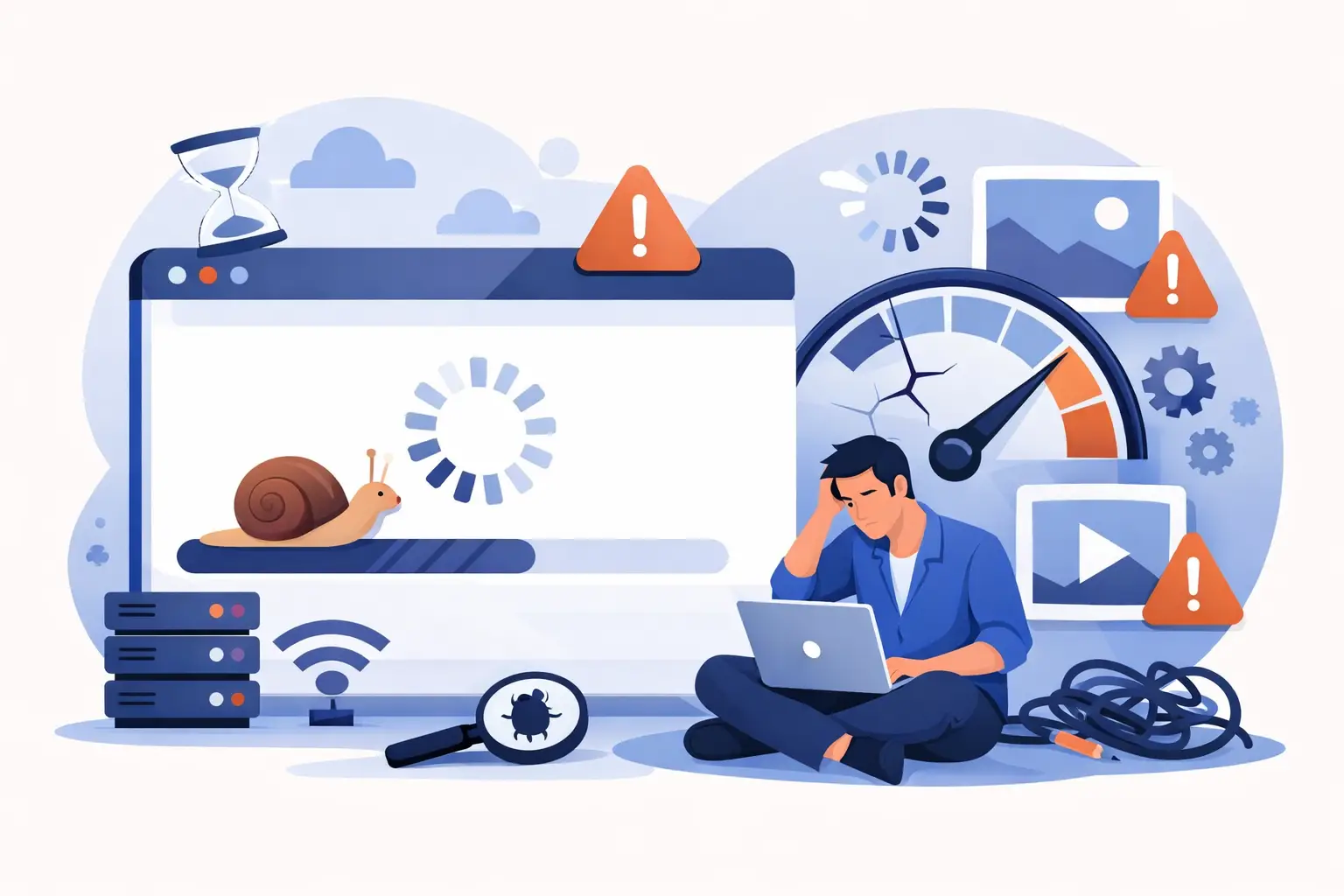
A potential customer has searched for your business, clicked through, and is ready to act. Then the page hangs on a blank screen, images appear one at a time, or the checkout takes too long to respond. That is the commercial answer to why do websites load slowly: every unnecessary second gives a visitor time to leave, compare competitors, or abandon a valuable inquiry.
For businesses, institutions, and eCommerce brands, website speed is not a technical detail to review only when something breaks. It affects brand perception, lead generation, search performance, advertising efficiency, and customer confidence. A fast site feels credible and prepared. A slow one can make even a well-designed business look outdated.
Why Do Websites Load Slowly for Real Visitors?
A website does not load from one place. It brings together a web server, domain settings, code, images, fonts, databases, third-party tools, and the visitor’s own device and connection. A delay in any one area can be noticeable. When several issues occur at once, the result is a site that feels frustratingly slow.
The key is to diagnose the full journey rather than assume a single cause. A homepage may perform well on an office connection but struggle on a mobile network. A product page may look fast until its filtering tools, payment services, promotional pop-ups, and high-resolution images are active. Speed testing should reflect the way real customers use the site, especially on mobile.
Oversized Images and Video Files
Large visual files are among the most common causes of slow websites. A banner image exported at far higher dimensions than the screen requires can add several megabytes to a page. Multiply that by galleries, team photos, products, and background sections, and the visitor is asked to download far more data than necessary.
Video deserves the same attention. A high-impact background video can strengthen a brand story, but it is not always the right choice for every page or audience. If it delays the main message, it creates a trade-off between visual ambition and performance. Videos should be compressed, loaded intelligently, and used where they contribute real value.
Modern image formats, correctly sized assets, and deferred loading for below-the-fold media can make a meaningful difference without reducing visual quality. The goal is not to make the site plain. It is to deliver the right asset at the right size and time.
Slow or Poorly Configured Hosting
Hosting is the foundation beneath every website. An underpowered server, overloaded shared environment, distant data center, or outdated server configuration can delay the time it takes for a website to begin responding. No amount of front-end design refinement fully compensates for an unreliable hosting setup.
This becomes particularly important for websites with seasonal campaigns, major announcements, eCommerce sales, or high traffic from paid advertising. A server that works under normal conditions may slow down when many visitors arrive at the same moment. Database-intensive sites, booking platforms, and online stores also need hosting resources that match their actual demand.
Reliable hosting should include appropriate server capacity, security maintenance, backups, caching support, and active monitoring. The lowest hosting price is rarely the lowest business cost if lost speed leads to lost leads.
Heavy Code, Themes, and Plugins
Many sites become slow over time rather than all at once. A new plugin is added for a form, then another for analytics, another for pop-ups, another for social feeds, and another for a temporary campaign that is never removed. Each addition may introduce scripts, style sheets, database requests, and conflicts.
Pre-built themes can create a similar problem. They are often designed to serve many possible layouts and features, including those a specific business will never use. That flexibility can mean unnecessary code is delivered to every visitor. Custom development, or careful theme optimization, provides greater control over what is actually loaded.
A performance review should identify unused plugins, duplicated functions, outdated extensions, and scripts that block key content from appearing. Removing unnecessary technology is often more effective than adding another optimization tool on top of it.
Too Many External Requests
A modern website may call on services outside its own server for advertising tags, chat widgets, maps, social media feeds, booking platforms, review tools, consent banners, tracking pixels, and embedded content. These features can be useful, but each one creates another dependency.
If an external service responds slowly, it can affect the page experience even when your own server is performing well. Marketing teams should not have to choose between measurement and speed, but they should audit which tools are essential. A tag that no longer supports an active campaign should not remain on the site by default.
The Business Cost of a Slow Website
Visitors do not separate technical performance from the quality of your organization. They judge the experience in front of them. If pages take too long to load, forms fail to respond, or checkout steps lag, trust declines before a conversation even begins.
Slow performance can also weaken search visibility. Search engines aim to send users to pages that provide a useful experience, particularly on mobile. Speed is one of several factors, alongside content quality, relevance, technical structure, and authority. A fast site alone will not guarantee rankings, but a slow site can make strong SEO work harder to convert into results.
For paid campaigns, the impact is even more immediate. Every click has a cost. When an ad leads to a slow landing page, the business may pay for visitors who never see the offer, complete the form, or make a purchase. Improving page speed can increase the value of the same advertising budget.
How to Find the Real Performance Problem
Speed issues should be measured before they are fixed. Start with a performance audit that reviews priority pages, not just the homepage. For many businesses, this includes service pages, campaign landing pages, contact forms, product pages, category pages, and checkout.
Look at loading behavior on both desktop and mobile, and test on a realistic connection rather than only a high-speed office network. Review the largest page elements, server response time, code files, database activity, caching, and external scripts. Technical metrics are useful, but pair them with practical questions: Does the main message appear quickly? Can a visitor use the navigation without delay? Is the form responsive? Does the purchase process remain fast at busy times?
It also helps to review changes over time. If speed declined after a redesign, marketing integration, plugin update, or product catalog expansion, that timing provides a strong clue. Performance optimization works best when it is treated as ongoing maintenance, not a one-time emergency task.
Practical Fixes That Deliver Better Website Speed
The right solution depends on the site, its platform, traffic, and commercial goals. A small professional services site needs a different approach from a large online store. Still, most improvement plans begin with four areas:
- Optimize images, videos, fonts, and downloadable files so visitors receive only what they need.
- Enable effective caching and content delivery methods to reduce repeated loading work.
- Clean up unused plugins, scripts, themes, and database records that add weight or delay.
- Upgrade hosting and server configuration when the current environment cannot support the site’s traffic or functionality.
After those foundations are addressed, development teams can refine code delivery, reduce unnecessary requests, defer nonessential resources, and improve database queries. For eCommerce websites, attention should also go to product filtering, inventory connections, payment gateways, and checkout performance. A beautiful product page has limited value if the cart becomes slow at the moment of purchase.
Do not optimize blindly. Removing a marketing tool, interactive feature, or security layer may improve a score while harming the business in another way. The strongest approach protects the functions that matter while reducing the waste around them.
Build Speed Into Every Website Decision
Performance is easier and more cost-effective to protect during planning than to repair after launch. Before approving a new feature, campaign page, animation, or third-party integration, ask what it will add to the visitor experience and what it will require from the browser and server.
InteracOman approaches website performance as part of a wider digital foundation: considered design, purposeful development, reliable hosting, and marketing that leads visitors to pages ready to convert. With more than 1,000 websites powered, the lesson remains consistent: digital growth is stronger when creative impact and technical discipline work together.
A faster website is not simply a cleaner technical score. It is a clearer first impression, a more efficient path to inquiry, and a better reason for customers to stay long enough to choose your business. If your site feels slow, treat that signal as an opportunity to improve the experience your audience is already asking for.



0 Comments